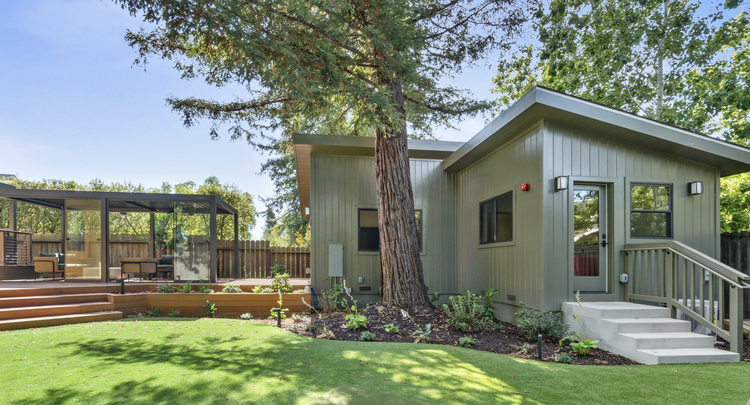
In California, building an ADU generally adds a new assessment for the new construction rather than reassessing your entire existing home at today’s market value. The untouched home and land normally keep their existing factored base-year values, while taxes increase for the value added by the ADU. Ordinary annual adjustments and other events affecting the property can still change the bill separately.
That distinction matters for San Jose homeowners who bought years ago and worry about losing their Proposition 13 assessment. An ADU can increase ongoing expenses, but the useful budgeting question is how much taxable value the project adds. It is not simply what your entire property could sell for after construction.
How new-construction reassessment works
California’s Board of Equalization explains that completed new construction receives a new base-year value for the increment of market value added. The existing property’s value is not reset just because the addition was built. Santa Clara County’s new-construction brochure applies that approach specifically to accessory dwelling units.
Think of the assessment as having components with different starting dates. The original house and land retain their existing assessment history, while the new improvement receives a value based on the construction event. This is a way to understand the process, not a separate tax account or a promise about a future sale.
Avoid describing the original assessment as permanently frozen. Proposition 13’s ordinary factored adjustments can continue, and a separate change in ownership or other assessable work may have its own consequences. Tell the Assessor about the whole project if the ADU is being built alongside a major main-house renovation.
What “added value” means
Your construction budget is useful evidence, but it is not automatically the assessment. The Assessor determines the market value attributable to the new work. The County says it typically uses construction cost or market-based sales comparisons to value the improvements separately; the applicable method depends on the property.
A contractor’s estimate and an assessor’s valuation answer different questions. One describes what you expect to pay for a particular scope. The other establishes taxable value under property-tax rules. Neither a real estate listing estimate nor a neighbor’s tax increase determines your assessment.
Keep the signed scope, plans, approved changes, final invoices, and a record of what existed before construction. Separate the ADU work from unrelated repairs or improvements in your records. This makes a discussion about the project easier without assuming any particular invoice item will be treated a certain way.
Ask how your proposed project will be evaluated before relying on a rough tax estimate. The Assessor can explain the process and required documentation, although a preliminary conversation is not necessarily a final valuation. The design team can help describe the construction accurately; it cannot set the County’s assessment.
A simple tax-budget example
For a preliminary annual estimate, multiply the assessable added value by the applicable percentage rate. Then review any changes in other assessments or charges separately. Your current bill helps identify the components, but dividing its entire total by assessed value can mix percentage-based taxes with fixed charges.
Here is arithmetic only, not an EDR price or a County valuation: if added assessed value were $200,000 and an illustrative percentage rate were 1.2%, the added percentage-based tax would be $2,400 per year, or $200 per month. Those assumptions are examples, not typical project figures or a quoted San Jose tax rate.
Replace the assumptions with parcel-specific information before using the result in a financing or rental decision. Carry the estimated monthly amount in the operating budget alongside insurance, maintenance, utilities, and debt payments. A budget that includes the annual tax effect is more useful than one focused only on construction.
When the increase reaches the bill
New construction can affect more than the next regular annual bill. The County’s supplemental-tax guidance explains that completed construction can create a supplemental assessment for the newly constructed portion. Ask how the completion date affects the assessment period and when notices or bills may arrive.
Construction that remains partly complete on January 1 can also be assessed in its unfinished state. Do not assume there is no tax impact until someone moves into the ADU. Ask the Assessor which records and dates it uses for your project, especially when work crosses calendar years.
Set aside a reserve while the assessment is being processed. Confirm with your mortgage servicer whether it will handle any supplemental bill or whether you must pay it directly. Delayed paperwork does not necessarily mean the improvement has no tax consequence.
Garage conversion versus detached ADU
Converting existing space does not automatically avoid reassessment. Santa Clara County’s brochure explains that alterations converting a garage or other existing area into an ADU can add assessed value even without adding floor area. New systems and the extent of reconstruction matter; an area rebuilt to the substantial equivalent of new may be treated accordingly.
An untouched part of the home is a different matter from the area being converted. Describe which walls, rooms, utilities, and structures change instead of calling the entire project simply a “remodel.” Photos and plans can help show the boundary of the work.
A detached ADU adds a new structure, while a conversion changes existing space. Their tax effects may differ, but a conversion is not guaranteed to produce a particular discount. Compare complete construction costs and ask the Assessor about each concept before choosing a design mainly for an assumed tax saving.
Renting introduces separate income-tax questions
Property tax and rental income tax are different systems. Rent generally creates reportable rental income, while eligible expenses and depreciation may affect the taxable result. The IRS’s Publication 527 explains the general framework, including allocating shared costs between rental and personal use.
Keep rental records separate from the household budget and speak with a tax professional about your situation. Financing, personal use, below-market family arrangements, and a later sale can change the analysis. Do not assume that the entire ADU construction cost is immediately deductible or that rent collected equals after-tax profit.
Where to confirm Santa Clara County details
Use the Santa Clara County Assessor’s official website and its New Construction and Property Taxes brochure linked below. Prepare your parcel information, a short scope description, preliminary plans, and questions about added value, conversion work, and timing. The Assessor handles valuation; billing and payment questions may need the County tax collector.
Read any assessment notice promptly and compare the project description with your records. If something appears incorrect, ask about the review process and applicable deadlines rather than waiting for the next bill. An informal conversation and a formal assessment appeal are different steps.
Frequently asked questions
Will an ADU reset the value of my whole house?
The ADU construction by itself generally adds an assessment for the new work. Separate ownership changes or substantial work elsewhere need their own review.
Is the added assessment always my construction price?
No. Project cost is relevant information, but the Assessor determines the added market value under the applicable rules.
Does a garage conversion avoid property tax increases?
No. Changing existing space into living accommodation can add taxable value without increasing the footprint.
Does housing a parent make the ADU tax-free?
Do not assume so. Ask the Assessor and your tax adviser about any specific exclusion or personal circumstance before budgeting around it.
Include taxes in the early ADU conversation
If you are planning an ADU in San Jose or the South Bay, an EDR consultation can help define the construction scope and cost questions to take to the Assessor. A clear project description makes it easier to plan for both building expenses and the ongoing cost of ownership.
Request an EDR consultation:
https://www.edremodel.com/contact
Sources and further reading
Sources reviewed October 30, 2026. Confirm current requirements before making project, tax, or rental decisions.
https://www.boe.ca.gov/proptaxes/newconstructionproperty.htm